
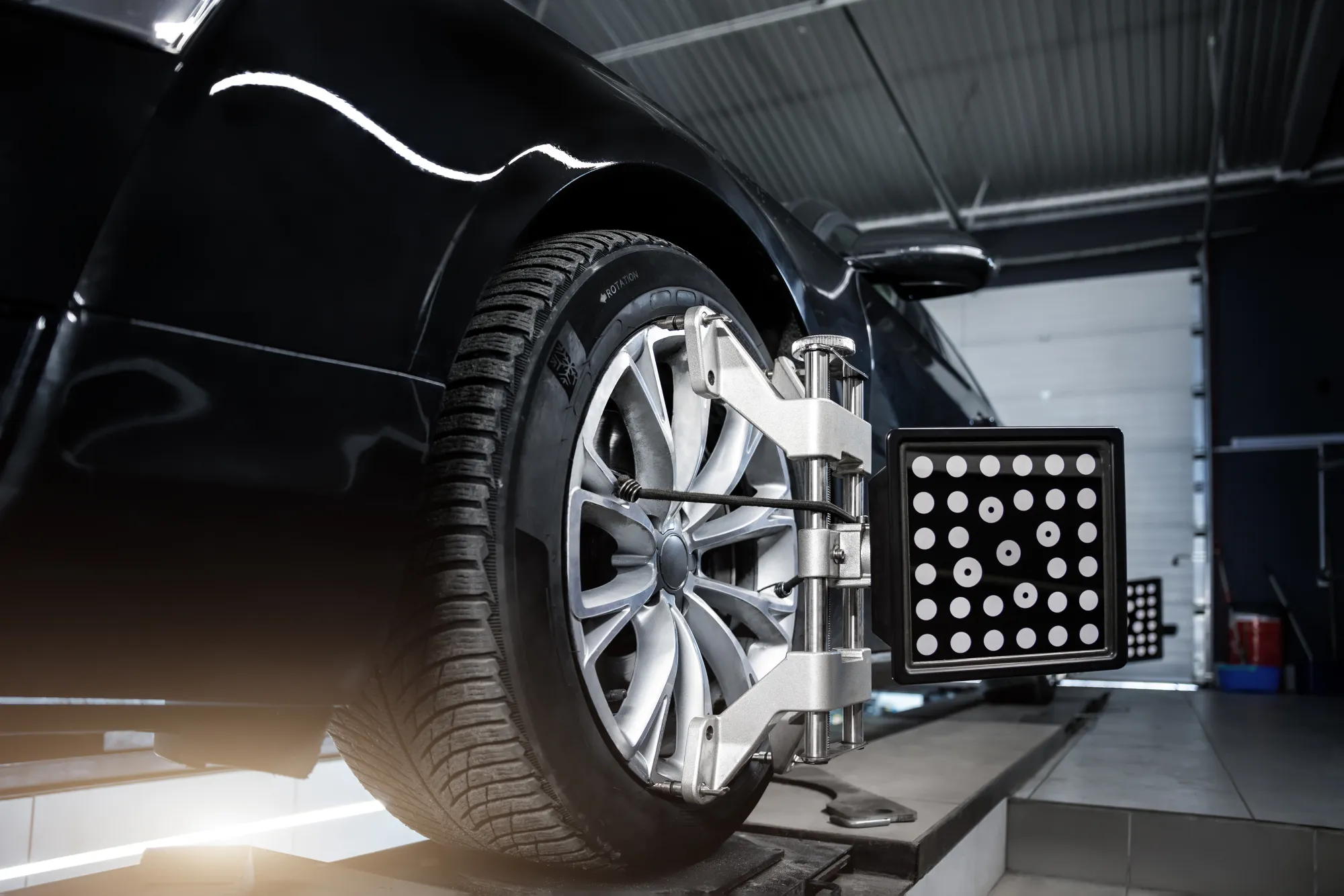
Somebody comes to the counter and says it plainly: “I think it’s just a wheel bearing.” Nine times out of ten they’re right about the part. What they don’t know yet is that the sentence describes two completely different repairs, and which one they get isn’t up to us.
On one vehicle, that bearing is a sealed unit that bolts to the steering knuckle: pull the wheel, take a few fasteners out, the old one comes off and the new one goes on. On the vehicle parked next to it, the bearing lives pressed inside the knuckle, and getting it out means separating parts under a shop press with the right adapters. Same noise, same corner of the car, two jobs that share nothing but a name.
That difference usually decides whether we hand you the keys today or call you tomorrow when a kit arrives. So when someone asks what wheel bearing replacement in Athens GA runs, the first thing we do is look up which of the two repairs their vehicle takes.
Wheel bearing noise is one thing. The repair behind it is two.
Wheel bearing noise is a symptom, and a fairly honest one. It usually shows up as a hum, a rumble, or a growl that tracks with road speed rather than engine speed, which is why it fools people into thinking they need tires.
Timken, which has been making these bearings a long time, says the same from the technician’s side: humming, rumbling, and growling point at tires, electrical, or drivetrain components first. When it really is bearing-related, the noise shows up while driving straight and gets worse when you turn the wheel slightly. And here’s the part that surprises people: typically the side opposite the rumbling is the defective side.
Snapping, clicking, or popping on a sharp turn can mean excessive bearing endplay from a loss of clamping, though it can just as easily be a worn outer CV joint. Grinding while the vehicle is moving suggests a loss of integrity inside the bearing, like damage to a roller or raceway.
None of it tells us which repair ends up on the ticket, though. Only how your vehicle was built does that.
What a hub assembly replacement actually involves
If your vehicle uses a bolt-on hub unit, a hub assembly replacement is mostly a sequence of fasteners. Timken’s light-vehicle procedure rates it as intermediate skill, with the special tools being an axle nut socket, a puller, and a torque wrench.
The order goes like this. Raise the vehicle, pull the wheel, remove the caliper and rotor, then the axle nut. Disconnect the ABS sensor wire from its connector and clips, noting how it was routed. Then out come the steering knuckle bolts, sometimes with a puller, because a hub that’s sat in Georgia humidity for a decade doesn’t always want to leave.
Going back together, the mounting bolts and the axle nut both get torqued to the manufacturer’s specification with an actual torque wrench. Timken is direct about it: do not use an impact wrench. Clamp load at the wheel end is what keeps the bearing set correctly, and an impact gun has no idea how much it just applied.
These units are sealed and aren’t meant to be opened. Timken’s warning is blunt: do not attempt to disassemble and reassemble unitized wheel end hubs and bearing assemblies, because improper reassembly can lead to failure. When the bearing inside is done, the assembly is done, which is why we quote a hub assembly replacement and not a bearing. The upside is availability: if the unit is on the shelf at your store, this is often a same-day job.
What a pressed-in bearing actually involves
Now the other vehicle. On a lot of older front-wheel-drive cars, the bearing is what SKF calls a Generation 1 hub unit: a double-row ball bearing with a one-piece outer ring and a split inner ring, pre-adjusted, greased, and sealed at the factory. It doesn’t bolt to anything. As SKF describes the layout, the bearing is pressed into the rear of the steering knuckle while the hub is pressed in from the front.
Getting that apart takes proper pullers to separate the CV joint, hub, and knuckle without damaging any of them. Then the new bearing goes in under a press, and this is where the job earns its labor time. SKF specifies that pressure be applied only to the outer ring when pressing the bearing into the knuckle, and only to the inner ring and hub when pressing the hub in. Put the force on the wrong part and, in SKF’s words, it will render the bearing useless by severely damaging the balls and raceways. A new part, ruined during installation, with no way to tell by looking.
That is slow work. The bearing gets rotated after each step to check for binding, and a snap ring goes in where the design calls for one, since pressing locks the bearing radially but not axially. The knuckle bore gets inspected for distortion or out-of-roundness first, because any irregularity there will load the bearing wrong and make it fail early; SKF says replace the knuckle if you’re in doubt.
There’s also more in the box. SKF’s position is that when one of these bearings is worn, it’s often more than the bearing that should be replaced, because the hub may have been damaged in service or during removal, so their kits come as hub, bearing, circlip, and axle nut. The axle nut never gets reused, since most self-locking nuts are deformed to hold torque and lose their holding ability once used. Final torque happens with the wheels back on the ground, which is what mates the split inner rings so the bearing ends up with the right internal clearance.
That’s a longer job with more parts in it, and if the kit isn’t in stock it waits on a delivery.
Which one your vehicle has isn’t a choice anyone at the counter makes
There’s a rough pattern: the press-in designs skew old. The applications SKF lists for those Generation 1 kits are cars like the 1991 to 1995 Ford Taurus and the Toyota Corolla from 1987 to 2002. Newer vehicles lean toward integrated bolt-on units instead. Timken’s current generation of hub and bearing assembly carries sensors inside it for ABS and traction control, plus sealing meant to keep contaminants out, and it’s built to be installed and replaced as one piece.
But “rough pattern” is doing real work there, which is why we look your vehicle up instead of guessing. Front and rear on the same vehicle can differ, and so can two trim levels of the same model. The counter answer is a lookup, not a hunch.
How our techs confirm it’s the bearing and not your tires
We don’t want to sell you a bearing you don’t need, and a hum has plenty of possible authors. So we work through it:
- Load the wheel. A short drive at road speed, straight, then a gentle sway left and right. If the noise rises and falls with the load transfer, that points at a wheel end, and remember the quiet side is often the bad one.
- Spin the hub on the lift. Wheel off the ground, brake drag out of the equation, listening and feeling for a rough, gritty, or uneven turn.
- Check for play. Hands at twelve and six, then three and nine, feeling for movement that shouldn’t be there.
Here’s the honest part, and it’s why we won’t diagnose this over the phone. A bearing that’s loud under the weight of the car can show no measurable play with the wheel hanging in the air, because loads on a lift are nothing like loads on Highway 316. A quiet hub doesn’t clear the bearing, and a little roughness by itself doesn’t convict it.
Local detail helps more than you’d think. Most front hub bearing repair in Danielsville starts with somebody describing a growl on Highway 98 that changes when the road crowns, and which way they were turning when it got worse. Same with a lifted truck out of Dawsonville on heavier wheels and tires, where the wheel end carries loads it wasn’t designed around and the hum shows up sooner. If it only speaks up in stop-and-go traffic on Buford Highway, say that too.
Why an ABS light and a tire pressure light can trace back to one hub
On many modern vehicles the ABS wheel speed sensor isn’t a separate part bolted nearby. It’s built into the hub assembly. Timken’s procedure has you disconnecting that sensor wire during removal, and notes the new sensor comes already attached to the new bearing.
So a hub problem can announce itself as a warning lamp instead of a noise. Timken notes that in extreme cases too much end-play creates enough movement to damage internal and external sensors. The flip side: replacing the assembly replaces the sensor too.
The tire pressure light can join in, depending on how your vehicle monitors pressure. Federal safety rules describe two approaches. Direct systems have a pressure sensor in each wheel that transmits a reading. Indirect systems have no tire pressure sensors at all and instead rely on the wheel speed sensors, typically part of the anti-lock braking system, to compare how fast each wheel turns, since those differences correlate to differences in tire pressure.
Read that again with a bad hub in mind. If your vehicle calculates tire pressure from wheel speed and that sensor rides on the failing assembly, one worn hub can put up a low tire warning on a tire that’s perfectly fine. So if you’ve been chasing a pressure light and adding air to a tire that isn’t losing any, mention it.
What living with the noise actually costs you
Bearings rarely get quieter, and the failure doesn’t stay in its lane.
Timken points out that severe bearing looseness can create excessive runout, which can make the brakes pulsate or pull and lead to uneven wear on the pads and rotor. To be fair, the same guide notes the most common cause of those brake complaints is a warped rotor from a caliper that isn’t retracting, not a bearing. But we do see the bearing version, and when it happens you’re buying brake parts that were fine when the noise started.
There’s also the repair growing on you. On a press-in design, the longer a damaged bearing runs, the more likely the knuckle bore and hub take damage too, and a bearing job that turns into a bearing and a knuckle is a different conversation entirely.
Georgia won’t catch it for you either. The state’s inspection program is emissions testing only, not a safety inspection, and only for gasoline passenger vehicles registered in 13 metro Atlanta counties. Nothing in your registration cycle looks at your wheel ends. Either you notice the noise, or a technician catches it while your vehicle is up for tires, brakes, or a wheel alignment.
What drives the cost, and why you’ll have to ask us
We don’t publish numbers for this job, and it isn’t coyness. The same complaint produces genuinely different tickets. What moves it:
- Which design your vehicle uses. A bolt-on hub unit is a larger part with less labor behind it. A press-in bearing is a smaller part with far more labor, setup, and press time.
- How many parts the job properly includes. A press-in repair often means a kit with the hub, circlip, and a new axle nut.
- What the tech finds once it’s open. A knuckle bore that’s out of round changes the job, and so does corrosion.
- Whether the part is on the shelf at your store. Stocked means today, ordered means scheduled, and stock differs between Athens, Danielsville, Dawsonville, and Buford Highway.
So let us look up your vehicle, tell you which of the two repairs it takes, and give you a current price on that. It’s a short conversation, and more accurate than any average you found online.
Bring it to the closest store and we’ll tell you which one it is
We’ve been doing wheel work in this part of Georgia since 1956, and a growl from one corner is one of the more satisfying things to chase down, because there is usually a clear answer waiting at the end of it.
Come see us on Mitchell Bridge Road or Lexington Road in Athens, at the Danielsville store if you’re in Madison County, in Dawsonville, or on Buford Highway in Atlanta. Bring what you’ve noticed: the speed it starts, whether turning changes it, whether any lights came on.
When you’re ready, request a quote, tell us your vehicle and which corner the noise comes from, and pick the store nearest you. We’ll confirm which of the two repairs it actually takes and give you a current price for it.